
Description
Cylindrical Mounts (O Mounts) – Versatile Rubber Vibration Isolators
Overview
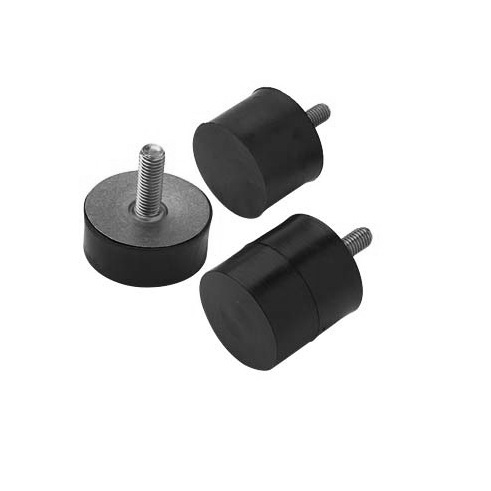
Cylindrical mounts, also known as O mounts or bobbin mounts, are simple yet effective rubber vibration isolators consisting of a cylindrical rubber element bonded between two metal plates with threaded studs. The design provides vibration isolation in compression, tension and shear, making them suitable for a wide variety of applications.
Features
- Simple cylindrical rubber-metal bonded construction
- Dual-stud design allows compression and tension loading
- Isolation in multiple directions (compression, tension, shear)
- Compact and lightweight design
- Cost-effective vibration isolation solution
- Available in numerous sizes and rubber hardness grades
- Standard metric and imperial stud threads
Applications
Cylindrical O mounts are used in:
- Industrial machinery and workshop equipment
- Small pumps, fans and motors
- Automotive and vehicle applications
- Electronic equipment and control panels
- HVAC equipment and small air handling units
- Laboratory and medical equipment
- Marine and transportation vibration isolation
Technical Specifications
- Material: Natural rubber
- Stud Types: Male-male, male-female, female-female
- Standard Sizes: 15mm to 100mm diameter, 10mm to 120mm height
- Load Range: 5 kg to 150 kg per mount
Common Mounting Configurations
Male-Male (Type 1):
Threaded studs on both sides, equipment bolts from top, base bolts from bottom.
Male-Female (Type 2):
One threaded stud, one threaded insert. Provides different mounting flexibility.
Female-Female (Type 3):
Threaded inserts on both sides. Bolts thread into mount from both directions.
Benefits
- Versatile mounting options for various configurations
- Good vibration isolation for light to medium loads
- Resistant to oils, chemicals and weathering
- Easy to install and replace
- Wide selection of sizes and load capacities
- Can be used in compression or tension
- Long service life with minimal maintenance
Selection Guidelines
Choose cylindrical O mounts based on:
- Equipment weight and number of mounting points
- Type of vibration (frequency and amplitude)
- Operating environment (temperature, chemicals)
- Mounting configuration (space constraints)
- Rubber hardness for required deflection
Contact our team for O mount selection assistance and vibration isolation calculations.