

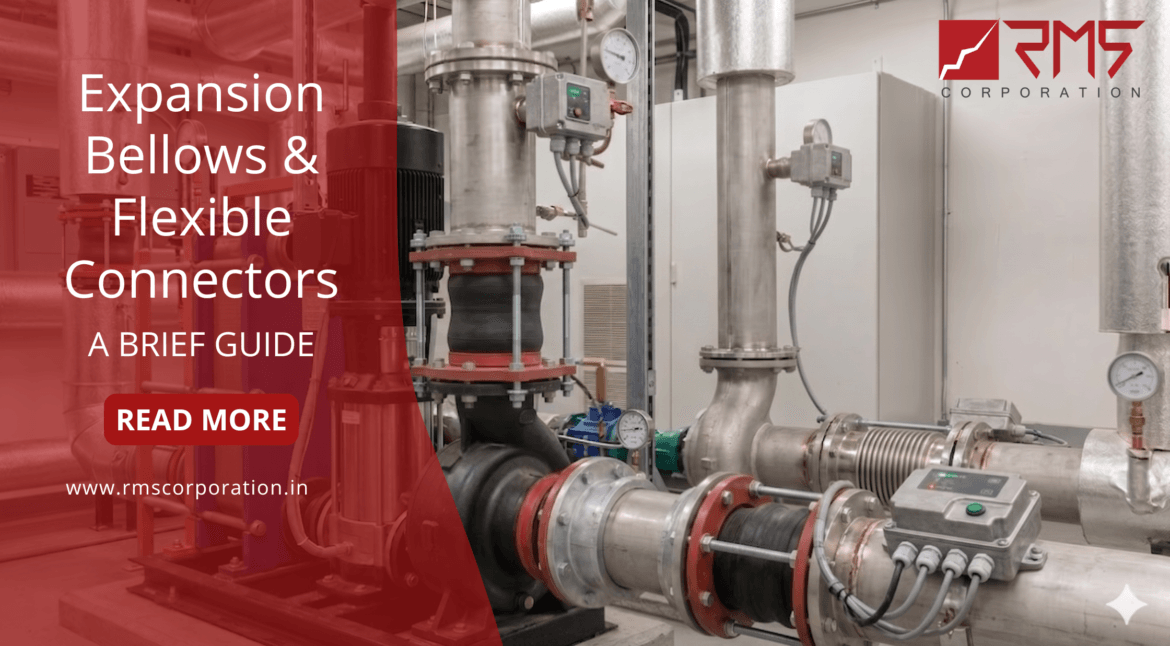
Every piping system that carries fluid — whether chilled water, hot water, steam, exhaust gas, or process media — expands and contracts with temperature. A 50-metre run of steel pipe carrying hot water at 80°C expands by approximately 55mm relative to its cold installation length. If that movement has nowhere to go, it generates enormous stress at every fixed point — flanges crack, welds fail, valves distort, and in severe cases the pipe itself buckles. Expansion bellows provide the flexibility that allows the system to accommodate this movement safely.
Beyond thermal movement, expansion bellows serve a second equally important function — they isolate vibration. Every pump, compressor, fan, or engine connected to a pipework system generates vibration that propagates along the rigid pipe network. Without flexible connectors, this vibration transmits from the equipment directly into the building structure and into every other piece of equipment connected to the same pipe network. Flexible rubber bellows break this transmission path, containing the vibration to the isolated equipment and preventing its spread through the system.
RMS Corporation has supplied expansion bellows and flexible connectors for HVAC, power generation, industrial, and infrastructure projects across India and internationally for over 45 years, through manufacturing of Metal Expansion Bellows and its authorised distributorship of Resistoflex India Pvt. Ltd. — one of India’s most established manufacturers of rubber and metallic expansion bellows. This guide covers every product type in the RMS expansion bellows range, their applications, selection criteria, and installation requirements.
What Are Expansion Bellows?
An expansion bellow is a flexible element installed in a piping or ducting system to absorb one or more of the following: axial movement (compression or extension along the pipe axis), lateral movement (sideways deflection perpendicular to the pipe axis), angular movement (rotation about a point), vibration and dynamic loads, and misalignment between connected pipe ends.
The flexible element itself is made from either elastomeric rubber — which provides excellent vibration absorption and movement accommodation at moderate pressures and temperatures — or corrugated metal — which handles high pressures, high temperatures, and aggressive media that would degrade rubber. Both types are installed between flanged pipe ends and are retained either by fixed flanges welded or bolted permanently to the bellow body, or by floating flanges that slip over the bellow and can be positioned to match the existing pipe flange spacing.
The selection between rubber and metallic bellows, and between the various sub-types within each category, depends on five key parameters: the operating pressure, the operating temperature, the type and magnitude of movement to be accommodated, the nature of the fluid being carried, and the installation environment. Getting this selection wrong can result in bellow failure — ranging from rubber cracking or metallic fatigue cracking to complete separation of the pipe joint under pressure.
Types of Expansion Bellows Provided by RMS Corporation
Rubber Expansion Bellows with Floating Flanges
The Resistoflex Rubber Expansion Bellow with Floating Flanges is the most widely used flexible connector in HVAC chilled water and condenser water systems across India. It consists of a moulded rubber bellow body with integral steel reinforcement rings, flanged at each end with loose steel backup flanges that slip over the bellow ends and bolt to the adjacent pipe flanges. The floating flange design allows the connector to be installed without pre-stressing the bellow body, and allows removal and replacement without disturbing the pipe flanges.
The floating flange bellow accommodates all three types of movement simultaneously — axial, lateral, and angular — making it the most forgiving connector type for installations where pipe alignment is not perfectly controlled. This makes it particularly valuable in retrofit and maintenance applications where existing pipe flanges may not be precisely aligned.
Typical applications: Chilled water connections at pumps, chillers, and AHUs; condenser water connections at cooling towers and condensers; heating water connections at heat exchangers and boilers; domestic water pump connections.
Operating limits: Suitable for working pressures up to 25 bar and temperatures up to 90°C for standard rubber compounds; higher temperature grades available for hot water and low-pressure steam applications.
Rubber Bellows with Fixed Flanges
The Resistoflex Rubber Bellows with Fixed Flanges uses integral flanges moulded permanently into the bellow body ends with split retaining rings. Fixed flange bellows must be installed in precise axial alignment with the adjacent pipe flanges.
Typical applications: HVAC pump connections; industrial process water systems; fire fighting pump connections; pressurised heating systems.
Double Arch Rubber Bellow
The Resistoflex Double Arch Rubber Bellow features two arch profiles in the rubber body rather than the single arch of standard bellows. The double arch geometry provides significantly greater movement accommodation capacity — both axial compression and lateral deflection — than a single arch bellow of the same installed length. This makes it the preferred specification for applications where equipment movement is significant or where the pipe configuration limits the available installation length.
Typical applications: Large chiller connections where compressor start-up generates significant movement; pump installations on inertia bases that have greater movement than standard spring-mounted equipment; applications where a longer single bellow would be required but space is limited.
Metallic Expansion Bellows with Fixed Flanges
Where operating temperatures or pressures exceed the limits of rubber bellows, metallic expansion joints are required. The Resistoflex Metallic Expansion Joints with Fixed Flanges consist of a corrugated stainless steel or carbon steel bellow element with flanges welded permanently to the bellow ends. The corrugations in the metal bellow provide the flexibility — each corrugation can compress, extend, or deflect laterally, and the total movement capacity is the sum across all corrugations.
Metallic bellows can handle significantly higher pressures and temperatures than rubber types — working pressures up to 25 bar and temperatures up to 450°C are achievable depending on the material and design. They are the standard specification for steam systems, high-temperature hot water systems, exhaust systems, and industrial process piping carrying aggressive media that would degrade rubber.
Typical applications: Steam distribution pipework connections; high-temperature hot water systems; power plant pipework; industrial process piping; turbine exhaust connections, cooling tower pipes, chilled water applications, fire fighting pumps
Metallic Expansion Bellows with Floating Flanges
The Resistoflex Metallic Expansion Bellow with Floating Flanges combines the high-pressure and high-temperature capability of a metallic bellow with the installation flexibility of floating flanges. Like the rubber floating flange type, the loose backup flanges allow installation without pre-stressing the bellow and permit easier removal and replacement. This type is particularly useful in retrofit situations where existing pipe flanges may need to be matched without modification.
Typical applications: Steam system retrofits; process industry piping upgrades; cooling tower pipes, chilled water applications, fire fighting pumps, industrial plant maintenance situations where pipe flanges cannot be repositioned.
Axial Bellows
The Axial Bellows from RMS Corporation’s range are stainless steel corrugated bellows designed to absorb axial movement — compression and extension along the pipe centreline — in high-pressure, high-temperature piping systems. Unlike the multi-directional movement capability of rubber bellows, axial bellows are intended specifically for applications where the dominant movement is axial thermal expansion, with lateral and angular movement constrained by pipe guides and anchors.
Axial bellows require a properly designed pipe guide and anchor system to function correctly. Without guides to constrain lateral movement and anchors to direct the expansion forces through the bellow, the bellow will squirm — deforming laterally under pressure until it fails. The pipe design must include fixed anchors on each side of the bellow and intermediate guides to maintain alignment.
Typical applications: Steam and condensate pipework; high-temperature process piping; power plant main steam connections; district heating pipework.
Exhaust Bellows
Exhaust bellows are stainless steel flexible connectors designed specifically for generator and engine exhaust systems. They accommodate the thermal expansion of the exhaust pipe — which can reach 500°C or more at the turbocharger outlet — while absorbing the vibration from the engine that would otherwise transmit into the exhaust structure and the building. Exhaust bellows must withstand both the high gas temperature and the significant pulsating pressure from engine exhaust gas flow.
Typical applications: DG set exhaust connections from engine turbocharger outlet to exhaust silencer and stack; stationary engine exhaust systems; industrial furnace flue connections.
RMS Corporation supplies Exhaust Bellows for all standard generator sizes and custom sizes for special applications. The correct exhaust bellow must be specified for the engine’s exhaust temperature, pipe diameter, and expected movement — contact RMS Corporation’s engineering team for selection support.
Where Expansion Bellows Are Used — Industry Applications
HVAC and Building Services
Expansion bellows are a standard component in every HVAC chilled water, condenser water, and heating water system. They are installed at every connection between isolated equipment — pumps, chillers, AHUs, cooling towers — and the building pipework network. Their dual function of absorbing thermal movement and isolating vibration makes them an essential part of the complete HVAC vibration isolation system.
In a typical commercial HVAC installation, expansion bellows are installed at all pump connections (suction and discharge), all chiller water connections, all AHU connections, and all heat exchanger connections. The number of bellows in a large commercial building HVAC system routinely runs into the hundreds.
Power Generation
DG sets and generators require expansion bellows on their exhaust systems — to accommodate the thermal expansion of the exhaust pipe and absorb the engine vibration before it transmits into the exhaust structure. Exhaust bellows from RMS Corporation are specified for all standard generator installations from 15 kVA to multi-megawatt units.
Transformers and switchgear installations require bus duct bellows — metallic flexible connectors that accommodate the thermal expansion of bus duct runs while maintaining the electrical integrity of the busbar system. These are specialised products engineered for each installation.
Industrial and Process Applications
Industrial process piping carrying steam, hot water, process chemicals, and compressed gases all require expansion bellows at intervals determined by the pipe’s thermal expansion calculation. The selection of rubber or metallic bellows depends on the process fluid temperature, pressure, and chemical compatibility requirements.
Metro Rail and Infrastructure
Metro rail projects require expansion bellows on all station MEP pipework — chilled water, fire fighting, drainage, and compressed air systems — as well as on the bus duct and power distribution systems feeding the station electrical infrastructure. RMS Corporation supplied expansion bellows to the Mumbai Metro Rail Corporation, covering both the mechanical services piping and electrical infrastructure connections.
Rubber vs Metallic Expansion Bellows — Selection Guide
| Parameter | Rubber Bellows | Metallic Bellows |
|---|---|---|
| Maximum working pressure | Up to 25 bar (standard) | Up to 25 bar and above |
| Maximum temperature | Up to 90°C (standard rubber); up to 115°C (special compounds) | Up to 650°C (stainless steel) |
| Movement capacity — axial | Moderate | High (more corrugations = more travel) |
| Movement capacity — lateral | Good | Moderate |
| Media compatibility | Water, air, mild chemicals | Wide range including steam, aggressive chemicals |
| Media compatibility | Water, air, mild chemicals | Wide range including steam, aggressive chemicals |
| Best for | HVAC water systems, pump connections, general building services | Fire Fighting Systems, HVAC Systems, Exhaust Applications Steam, high-temperature, high-pressure industrial applications |
Installation Guidelines for Expansion Bellows
- Do not pre-stress the bellow during installation. The bellow should be installed in its natural, unstressed position. Stretching or compressing a bellow during installation consumes movement capacity that should be reserved for thermal expansion and equipment movement in service.
- Install control rods. Where system pressure is sufficient to generate significant pressure thrust forces control rods or tie bolts should be installed parallel to the bellow to resist the thrust force, preventing the bellow from extending under pressure and transferring the thrust to the pipe anchors.
- Ensure the pipe is properly guided and anchored. For axial bellows, the pipe guide and anchor system is critical to bellow performance. Without proper guides, the bellow will squirm under pressure. Guides should be located within 4 pipe diameters of each bellow end, and fixed anchors must be sized to resist the spring force and pressure thrust of the bellow.
- Protect rubber bellows from mechanical damage. Rubber bellows should not be painted, subjected to chemical cleaning agents, or exposed to oil or solvent contamination. They should not be used as a step or walkway. Install protective covers in locations where mechanical damage is possible.
- Inspect bellows periodically. Rubber bellows should be inspected annually for signs of cracking, bulging, flange leakage, or surface degradation. Metallic bellows should be inspected for corrosion, particularly at the bellow roots where stress concentrations occur. Any bellow showing signs of distress should be replaced before it fails in service.
Frequently Asked Questions
An expansion bellow is a flexible connector installed in a piping or ducting system to absorb thermal expansion, vibration, movement, and misalignment. Without expansion bellows, the thermal expansion and contraction of pipework generates stresses at fixed points that can crack flanges, fail welds, and distort valves. Bellows provide the flexibility to safely accommodate this movement while maintaining a pressure-tight seal.
Rubber expansion bellows are suited to pressures (up to 25 bar) and temperatures (up to 90°C for standard compounds) and provide excellent vibration absorption — they are the standard product for HVAC chilled water and condenser water systems. Metallic expansion joints handle higher pressures (up to 25 bar and above) and temperatures (up to 650°C) and are required for steam, high-temperature hot water, and industrial process piping where rubber would degrade.
A floating flange bellow has loose steel backup flanges that slip over the bellow ends and bolt to the adjacent pipe flanges. The flanges are not permanently attached to the bellow body — they float freely over the bellow ends. This allows easier installation without pre-stressing the bellow, and allows the bellow to be replaced without disturbing the pipe flanges. The floating flange type is the most commonly specified rubber bellow for HVAC applications.
Yes. Rubber expansion bellows have a service life of typically 6–12 years depending on operating temperature, pressure cycling frequency, and installation quality. They should be inspected annually and replaced when signs of cracking, surface hardening, or flange leakage appear.
Metallic bellows have a longer service life — 8–15 years — but are also subject to fatigue cracking in the bellow corrugations under cyclic thermal loading and should be inspected regularly.
Exhaust bellows made from stainless steel are the standard product for DG set and generator exhaust connections. They accommodate the thermal expansion of the exhaust pipe — which can reach 600°C at the turbocharger outlet — while absorbing engine vibration. RMS Corporation supplies exhaust bellows for all standard generator sizes and custom applications.
The terms are often used interchangeably, but there is a technical distinction. Flexible pipe connectors is a broader term that includes all types of flexible connections in a piping system — rubber bellows, metallic bellows, braided hose assemblies, and flexible joints. Expansion bellows specifically refers to connectors designed to accommodate the thermal expansion of the pipe system. In HVAC practice, rubber expansion bellows at pump and chiller connections serve primarily as vibration isolators rather than thermal expansion devices, since the equipment movement they accommodate is primarily vibration-induced rather than thermally driven.
The key parameters are pipe size (DN), operating pressure (bar), operating temperature (°C), movement requirement (axial, lateral, or angular, and the magnitude), and fluid compatibility. Share these parameters with RMS Corporation’s engineering team and we will recommend the correct Resistoflex product with full technical data and catalogue information. Our selection service is provided at no charge for all project enquiries.
Contact Us for your Bellow Requirements
We manufacture customised Metal Expansion Bellows as your requirement and are authorised distributors for Rubber and Metal Bellows of Resistoflex Ltd.