
Description
Inertia Pouring Frame – Concrete Inertia Base Systems
Overview
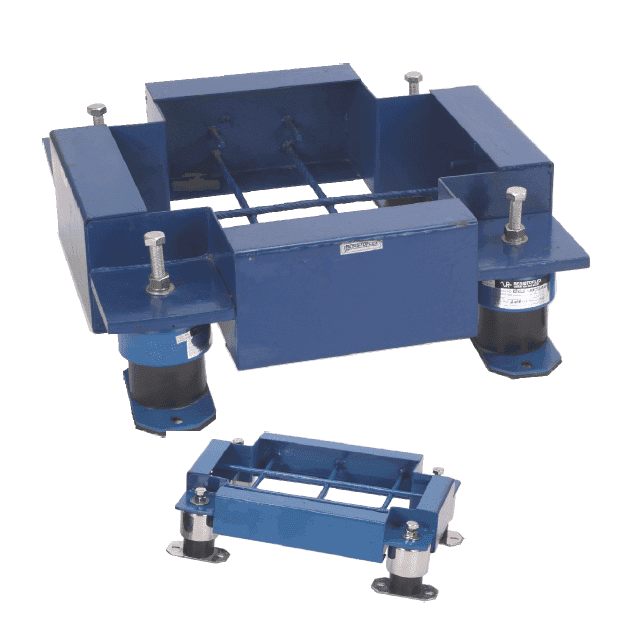
Inertia pouring frames are steel formwork systems used to create concrete inertia bases (also called inertia blocks) for pumps, compressors and rotating equipment. The inertia base adds mass to reduce vibration amplitude and provides a stable mounting platform for vibration isolators.
Features
- Heavy-gauge steel frame construction
- Designed for concrete pouring and curing
- Integrated mounting points for equipment and isolators
- Removable or permanent frame options
- Pre-drilled holes for anchor bolts
- Corrosion-resistant coating
- Custom sizes available
Applications
- Centrifugal pumps and pump assemblies
- Close-coupled pumps and vertical pumps
- Small compressors and vacuum pumps
- Motors and motor-driven equipment
- Any equipment requiring inertia base for vibration control
- Retrofit applications on existing floors
- Rooftop equipment installations
Why Use Inertia Bases
- Adds mass to reduce vibration amplitude
- Provides stable, level mounting platform
- Distributes equipment weight over larger area
- Improves vibration isolator performance
- Prevents rocking and instability
- Isolates equipment from floor irregularities
Design Guidelines
- Inertia base weight: minimum 1.5x to 2x equipment weight
- Thickness: typically 150mm to 300mm
- Extend 150-200mm beyond equipment footprint on all sides
Installation Process
- Position and level inertia pouring frame on floor
- Install vibration isolators under frame (if applicable)
- Place reinforcement mesh/rebar inside frame
- Pour and compact concrete to required level
- Embed anchor bolts for equipment mounting
- Allow concrete to cure per specifications
- Install equipment on cured inertia base
Benefits
- Improves vibration isolation effectiveness
- Reduces floor vibration and noise
- Provides stable mounting for equipment
- Distributes loads to prevent floor damage
- Cost-effective solution for vibration control
- Can be used for retrofit applications
Contact RMS Corporation for inertia frame sizing, concrete calculations and complete vibration isolation system design including spring or rubber isolators.