

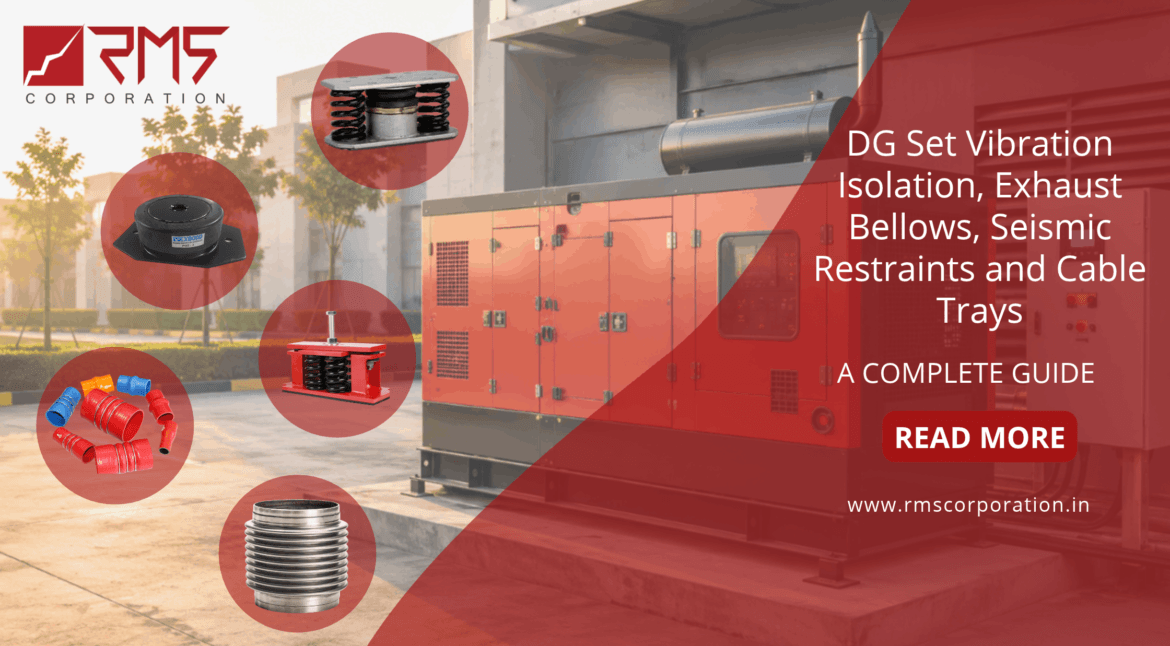
In this article:
Why Do DG Sets Need More Than Just Anti-Vibration Mounts?
Almost every commercial building, hospital, data centre, factory and residential tower in India has a diesel generator. It sits in a basement, on a podium, or on the roof, and for most of its life it does nothing. Then the power fails, it starts within seconds, runs under load for hours, and stops again.
That start-stop duty is what makes a DG set a harder vibration problem than a chiller or a pump. A chiller runs at a steady speed. A generator passes through its resonance every time it starts and every time it stops, and the load on the engine changes constantly in between.
Most installation problems come from treating the isolator as the whole job. A DG set is connected to the building in at least five ways:
- Its base, through the mounts or isolators
- The exhaust pipe, which carries gas at several hundred degrees
- The cables, carrying output power and control signals
- The fuel, cooling and ventilation connections
- The floor anchors, which matter in seismic zones
Vibration will travel through whichever of these is rigid. This guide covers each one and the RMS Corporation products that deal with it.
How Does a DG Set Vibrate?
In India, most DG sets run at 1500 RPM (4-pole alternator at 50 Hz). That gives a primary disturbing frequency of 25 Hz (1500 ÷ 60). On top of that, cylinder firing adds higher-frequency components, and the engine produces torque reaction, a twisting force that tries to rock the whole set sideways every time a cylinder fires.
Three types of vibration matter:
- Steady-state vibration while running, mostly at 25 Hz and its multiples. This is the one most people think of.
- Start-up and shutdown transients. As the engine speed ramps through the natural frequency of the mount system, the set can sway far more than it does at steady speed.
- Shock and torque loads when the generator picks up load suddenly, for example when an entire building transfers to DG power.
A good isolation design deals with all three. That is why DG sets are usually specified differently from other plant.
Step 1: Which Vibration Isolators Does a DG Set Need?
Isolator performance is set by static deflection, which is how much the mount compresses under the weight of the set.
The right choice depends on where the generator sits. A set on a ground-floor plinth with no occupied space nearby can accept far less isolation than one on the roof of a hospital.
Which isolator for which installation?
|
Installation |
Typical isolator |
|---|---|
|
Ground-floor plinth, small to medium set, no sensitive neighbours |
Gensafe rubber mounts |
|
Basement or podium, large set |
Spring isolators, often with rubber pads |
|
Upper floor or rooftop, occupied spaces below |
Spring isolators with viscous dampers, on an inertia base |
|
Seismic zone or critical facility |
Seismic restrained spring mounts |
This table is indicative. Final selection needs the operating weight, speed, centre of gravity, number of mounting points and the installation floor.
RMS Corporation products for DG set isolation:
- Gensafe Rubber Mounts: Rubber mounts engineered for the uneven vibration signature of diesel generators. They suit small and mid-size sets where space is limited and the building is not acoustically sensitive.
- Spring Isolators with Viscous Dampers: the standard answer for start-stop resonance. The damper limits how far the set sways as it passes through the mount frequency, which is why we recommend it for upper-floor and rooftop installations.
- Cushyfoot Mounting: heavy-duty rubber-to-metal bonded mounts for sets with high static loads.
- Seismic Restraint Mounts: Recommended for locations situated in seismic zones.
Do you still need isolators if the set has built-in mounts?
Many DG sets are supplied with small rubber mounts between the engine and alternator and the common base frame. These protect the set from its own vibration. They do not isolate the building from the set, so additional isolators between the base frame and the floor are normally needed when the generator is in or above occupied areas.
Step 2: Do DG Sets Need Exhaust Bellows?
Why the exhaust is the most commonly missed path
The exhaust pipe is rigid, hot and attached directly to the engine. It is the most common reason a well-mounted generator still shakes the building. If the pipe is rigidly connected to the engine, vibration runs along the pipe and into every wall and slab it touches. If the pipe is rigidly anchored while the engine moves on its mounts, the engine flange takes the load, and flanges crack.
An exhaust bellow fixes both problems. It is a flexible stainless steel connector that sits between the engine’s exhaust outlet and the exhaust pipe. It absorbs engine movement, absorbs vibration, and takes up thermal growth in the first section of pipe.
How hot does it get?
Manufacturer data sheets put diesel generator exhaust gas temperature at roughly 400-570°C at rated load: 406°C for a Cummins C3750 D5e set and 571°C for a Cat D350 GC set. Carbon steel expands by about 12 mm per metre for every 1000°C of temperature rise, so a 10 m run of exhaust pipe heated by roughly 470°C grows by about 56 mm. Without a flexible element, that movement goes straight into the engine, the silencer and the supports.
What to specify
Give your supplier the following when selecting an exhaust bellow:
- Engine make, model and kVA rating
- Exhaust pipe diameter (DN) and flange standard
- Maximum exhaust gas temperature
- Expected movement: axial, lateral and angular, from both thermal growth and engine movement on its mounts
- Installation space: how much length is available between the engine outlet and the first pipe support
Good installation practice:
- Fit the bellow as close to the engine outlet as practical, before the first rigid pipe support.
- Support the exhaust pipe independently from the building structure, using spring or flexible hangers. The pipe must never hang from the engine or the bellow.
- Do not use the bellow to correct misalignment beyond its rated movement. Align the flanges first.
- Install guides and anchors so the movement the bellow sees is the movement it was designed for.
- Use an internal liner (sleeve) where the design calls for it, to protect the corrugations from the pulsating gas flow and limit flow turbulence.
- Insulate the pipe and bellow, with a removable cover over the bellow so it can still be inspected.
- Inspect it regularly. Look for cracking at the corrugation roots, corrosion and distortion.
RMS Corporation exhaust bellows
RMS Corporation manufactures stainless steel metal expansion bellows and exhaust bellows for all standard generator sizes, as well as custom sizes and flange arrangements for special applications. Because we manufacture them, we can size the bellow to your engine data rather than forcing the engine to fit a standard part.
Other flexible connections on a DG set
- Fuel supply and return lines: flexible hoses or connectors, not rigid pipe.
- Turbo Charger Hoses: Silicon multi-ply hoses for your Turbo Charger.
- Remote radiator or cooling water lines: rubber expansion bellows on pipe connections.
- Radiator discharge and ventilation ducts: fire retardant canvas connectors, so duct vibration and noise do not spread through the building.
Step 3: Do DG Sets Need Seismic Restraints in India?
Why vibration isolators and earthquakes don’t mix
Spring isolators are designed to let the equipment move. That is exactly what you do not want in an earthquake. A generator sitting on soft springs can slide, rock, or jump off its mounts, tearing the exhaust, fuel and cable connections as it goes.
The DG set is also the one piece of plant a building depends on when the power fails after a seismic event. Hospitals, data centres, metro stations and other critical facilities typically specify seismic restraint for exactly this reason.
Do you need it in India?
India’s seismic zoning under IS 1893 (Part 1):2016 runs from Zone II (lowest) to Zone V (highest), and that standard is still the governing one as of March 2026. Mumbai is in Zone III (zone factor 0.16). Whether restraint is required for a particular project depends on the zone, the building’s importance, and the project specification. Hospitals, data centres, hotels and infrastructure projects often require it regardless, and international hospitality and healthcare specifications routinely do.
What a seismic restraint system does?
- Lets the isolator work normally under everyday vibration
- Limits horizontal and vertical movement during a seismic event
- Stops the equipment from overturning or leaving its base
- Transfers the seismic force safely into the building structure through anchor bolts
RMS Corporation seismic products
- Seismic Restrained Spring Mounts: spring isolators with built-in restraint, so one unit gives both vibration isolation and seismic protection. Recommended for generators in seismic zones and critical facilities.
- Seismic Products range: restraint solutions for other equipment, pipework and services in the DG room.
The anchor bolts and the concrete or steel they are fixed into must be designed for the seismic loads by the structural engineer. A restraint is only as strong as its anchorage.
Step 4: How Should DG Set Cables and Cable Trays Be Installed?
Cables are a vibration path too
The generator’s output cables run from the alternator terminal box to the changeover or synchronising panel, and the control and monitoring cables run alongside. If those cables are clamped rigidly between the isolated set and the building, vibration travels along them. Worse, a set that moves on its mounts can pull on rigidly clamped cables until the terminations fail.
Best practice for cables
- Leave a flexible loop or generous slack in every cable between the alternator terminal box and the first fixed support. The slack takes the movement of the set on its mounts.
- Terminate flexibly. Use flexible conduit, glands and cable connections that allow movement, and never attach the cable directly to a fixed structure at the generator.
- Separate power and control cables. Keep them on separate trays or well apart, to avoid interference with control and monitoring signals.
- Choose the right cable type for the duty. DG output cables must be rated for the load current and ambient temperature in the generator room. Emergency circuits in buildings often require fire-survival or fire-retardant cables. Check the project specification.
- Allow for heat. Generator rooms and canopies run hot, which reduces cable current capacity. Derate accordingly.
Cable trays
Cable trays carry the cables from the generator to the panel, so they have to be selected and fixed with the same care as the isolators.
- Ladder trays suit heavy power cables, give good ventilation and make it easy to tie cables down.
- Perforated trays suit control, instrumentation and lighter cables.
- Finish: hot-dip galvanised or stainless steel for rooftop and canopy installations, particularly in a coastal city like Mumbai where humidity and salt accelerate corrosion.
- Support the tray from the building structure, not from the isolated generator or its base frame. If the tray is bolted to the base frame, it becomes a rigid link.
- Break the tray before the generator. The last section of cable between the tray and the terminal box should be the flexible loop, free of the tray.
- Size the tray for the cables, with room for future additions and for the cable spacing that heat dissipation needs.
RMS Corporation cable management
RMS Corporation supplies Cable Management Systems including cable trays for DG installations and wider MEP projects. Share your cable schedule and the route from the generator to the panel, and we can advise on tray type, finish and supports.
Putting It All Together: A DG Set Isolation Checklist
Use this list at design stage and again at commissioning.
- Isolators: selected for operating weight, speed and floor level, with viscous dampers on upper floors or rooftops
- Inertia base: specified for large or tall sets
- Exhaust bellow: fitted close to the engine outlet, with the pipe supported independently
- Seismic restraints: specified where the zone or the project demands them, with anchorage designed by the structural engineer
- Cables: flexible loops at the alternator, power and control cables separated
- Cable trays: supported from the structure, never from the isolated base
- Fuel, cooling and duct connections: all flexible
Common DG Set Installation Mistakes
- Isolating the base but bolting the exhaust rigidly. The exhaust becomes the main vibration path, and the engine flange cracks.
- Using rubber mounts on a rooftop or upper-floor set. Rubber gives much less isolation than a spring at 25 Hz and offers little control of start-stop resonance. Use springs with viscous dampers.
- Hanging the exhaust pipe from the engine. The weight and thermal growth of the pipe load the turbocharger and engine outlet.
- Overloaded or underloaded isolators. A mount only delivers its rated deflection at its rated load. Calculate the load at each mount point.
- Tight cables. Cables strapped hard between the generator and a fixed tray get pulled and fatigued by the set’s movement.
- Cable tray fixed to the generator base frame. It short-circuits the isolation.
- Ignoring seismic restraint in critical or high-risk facilities, then discovering at handover that the specification required it.
Where Can You Buy DG Set Isolators and Exhaust Bellows in Mumbai?
RMS Corporation has supplied vibration isolation, expansion bellows and engineered products for projects across India and internationally for over 45 years, from our base in Goregaon, Mumbai. For DG set projects we can supply the isolators, exhaust bellows, seismic restraints and cable management from a single source. As a DG set vibration isolator and exhaust bellows supplier in Mumbai, shipping across India and globally, we give you one point of contact and one coordinated specification for your generator set or genset installation.
For a recommendation, send us:
- Generator make, model and kVA rating
- Operating weight (dry and wet)
- Engine speed in RPM
- Mounting points: number and position, or the base frame drawing
- Installation location: ground floor, basement, podium or rooftop
- Seismic zone and any project specification requirements
- Exhaust details: pipe size, flange standard and gas temperature
- Cable details: sizes, number of runs and the route to the panel
Our engineering team provides selection support at no charge for project enquiries.
Visit: Contact Us | Address: B-313, Virwani Industrial Estate, Goregaon (E), Mumbai – 400063
Frequently Asked Questions
Yes, in most buildings. Generators produce strong vibration at their running speed and during start-up and shutdown. Without isolation, that vibration transmits through the floor and structure into occupied spaces as noise and low-frequency vibration. Isolation is especially important where the set is on an upper floor, a podium or a rooftop, or close to hospital wards, hotel rooms, offices or apartments.
Spring isolators give far more deflection and therefore much better isolation at generator frequencies, so they are the right choice for upper floors, rooftops and sensitive locations. Rubber mounts such as Gensafe are suitable for small and mid-size sets at ground level where the building is not acoustically sensitive. For generators on upper floors, springs combined with viscous dampers are the usual specification.
A viscous damper is fitted alongside a spring isolator to control how far the set moves as it passes through the mount’s natural frequency during start-up and shutdown. Springs on their own have very little damping, so a generator can sway strongly at those moments. The damper limits that movement without reducing isolation at normal running speed.
Yes. The exhaust pipe is a rigid path for vibration, and it grows with heat. An exhaust bellow between the engine outlet and the pipe absorbs both the engine’s movement on its mounts and the thermal expansion of the pipe, protecting the engine flange, the silencer and the building.
Stainless steel, chosen for the gas temperature and the environment. The material grade and the number of plies depend on the engine’s exhaust gas temperature and pressure pulsation, so these details should be confirmed with your bellows manufacturer using the engine data. We can also manufacture this in Inconel if required.
As close to the engine exhaust outlet as practical, ahead of the first rigid pipe support. The pipe after the bellow should be supported independently from the building structure and never hung from the engine or the bellow.
It depends on the seismic zone, the building category and the project specification. Mumbai falls mostly in Seismic Zone III under IS 1893. Many hospitals, data centres, hotels and infrastructure projects specify seismic restraint for generators and other critical plant, and it is worth confirming early in the design stage.
Spring isolators with built-in restraint elements. In everyday operation they isolate vibration like any spring mount. In an earthquake, the restraint limits the movement of the equipment and keeps it anchored to the structure.
Ladder trays are the usual choice for heavy power cables, and perforated trays for control and instrumentation cables. For rooftop and canopy installations, hot-dip galvanised or stainless steel finishes resist corrosion. Always support the tray from the building structure, not from the generator or its base frame.
Yes. RMS Corporation supplies vibration isolators, exhaust bellows and other flexible connectors, seismic restraint products and cable management systems, and can coordinate the specification across them. Share your generator and installation details and our engineering team will recommend the right products.
